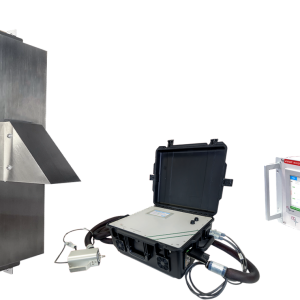
In plants with SCR or SNCR denitrification, ammonia slip is the unreacted ammonia that remains in the flue gas. Measuring NH3 (and HCl) continuously in hot, wet gas lets you dose the reagent precisely: enough to remove NOx, not so much as to create slip.
Why ammonia slip must be controlled
Too little reagent leaves nitrogen oxides in the flue gas; too much produces ammonia slip. Slip can exceed the emission limits and reacts with acid gases, such as HCl, to form ammonium salts that deposit and foul downstream equipment. The same need arises in waste-to-energy and incineration, cement, glass and metal industries.
SCR / SNCR
Compliance
Ammonium salts
Sampling
Laser and FTIR measurement on hot, wet gas
The ETG 6900 laser analyzer, in its heated-cell (-H) version, keeps the optical cell, the pump and the sample transfer line at 190 °C (up to 220 °C on request, optional heated probe), preventing acid gas condensation, ammonium salt deposition and sample loss. Laser sensors are available for NH3+H2O, HCl+H2O and others; the wall-mount cabinet can host up to three sensors.
The ETG 9500 FTIR measures many gases at the same time — NH3, HCl, HF, SO2, NOx, CO and more — with a heated cell up to 180 °C and optional heated pump, probe and filter, when the whole flue gas composition must be followed.
ETG analyzers for DeNOx control
Choose the laser analyzer for fast, selective measurement of ammonia and HCl; choose the FTIR when many compounds must be measured together.

ETG 6900

ETG 9500 FTIR
ETG 6900 — Rack 19" · Wall-mount · Portable
ETG 9500 FTIR — Rack 19" · Wall-mount · Portable
Spot measurements or temporary campaigns? The portable versions (P) offer the same analytical performance as the fixed versions.
Frequently asked questions
What is ammonia slip?
Why must the sample path be heated?
Laser or FTIR?
Can the analyzer connect to the plant control system?
Related applications
See also industrial emissions monitoring and chemical and process gas monitoring.